
Blog
How to Choose Who to Hire for After-the-Fact Roof Permits in FL
Who should a roofer hire for after-the-fact permits in Florida? Learn the team you need, how to vet them, and the steps to close the permit.
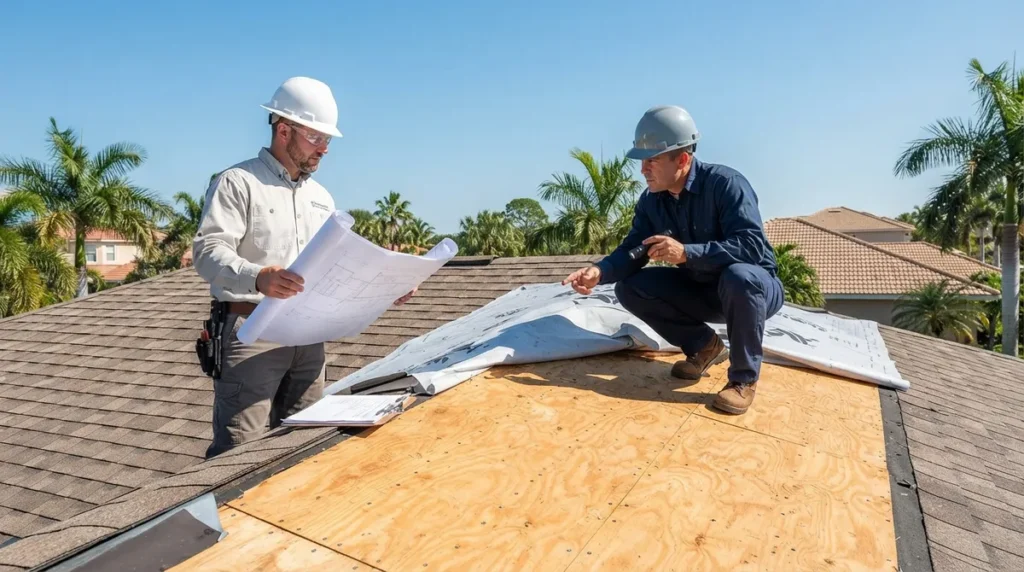
Key Takeaways
-
A Florida-licensed roofing contractor of record must sign on the after-the-fact permit, since Chapter 489 generally requires licensed trade work, and that contractor stays responsible for the work.
-
A permitting specialist can handle filing, tracking, and responding to reviewer comments, but cannot replace the licensed contractor or the building official, and cannot guarantee approval.
-
First identify the authority having jurisdiction (city, county, or special permitting area), since forms, fees, and inspection practices vary across Florida's many jurisdictions.
-
Expect inspectors to possibly require uncovering concealed components like decking, fasteners, and underlayment, so budget time and money for selective removal and reinspection.
-
Engage an engineer or drafter for sealed letters or as-built roof details when fastening, decking, or trusses cannot be easily verified from documentation or photos.
-
Avoid anyone promising guaranteed approval, offering to bypass or fake inspections, or asking you to misstate when or how the roof work was done.
So the roof is on, the crew has moved to the next job, and then someone mentions the word nobody wants to hear: permit. Maybe a homeowner is selling, an insurer asked for paperwork, or a code officer spotted a bare permit board. Take a breath. This happens more often than you would think, and it is fixable.
If you are a roofer in this spot, the big question is who should a roofer hire for after the fact permits in Florida? The short answer: a properly licensed roofing contractor of record, paired with a permitting specialist who knows the property's exact jurisdiction. Neither one replaces the other, and neither one replaces the building official, who makes the final call.
In this guide, we will walk through who does what, which professionals you may need, how to vet them, and the exact steps to follow. Whether you are a roofing contractor, a general contractor, a realtor, or a homeowner trying to clean up a mess, you will leave with a clear plan and a few red flags to avoid.
What an After-the-Fact Roof Permit Really Is
An after-the-fact (ATF) permit is a permit pulled for work that has already been completed. Florida generally requires a permit before regulated construction or repair begins, so a finished roof with no permit is out of sequence. The good news is that most building departments have a process to bring that work into compliance.
Miami-Dade County, for example, states that permits and inspections can still be obtained for work already completed without a permit. The process is similar to permitting new work, but inspectors may require portions of the roof to be uncovered so they can verify code compliance.
Here is the key point: the local building department, not a private consultant, decides whether the finished roof can be approved. Hiring help improves your odds of a smooth submission, but it cannot guarantee approval or waive code requirements. For a deeper look at the process, see our guide on how to get an after-the-fact permit in Florida.
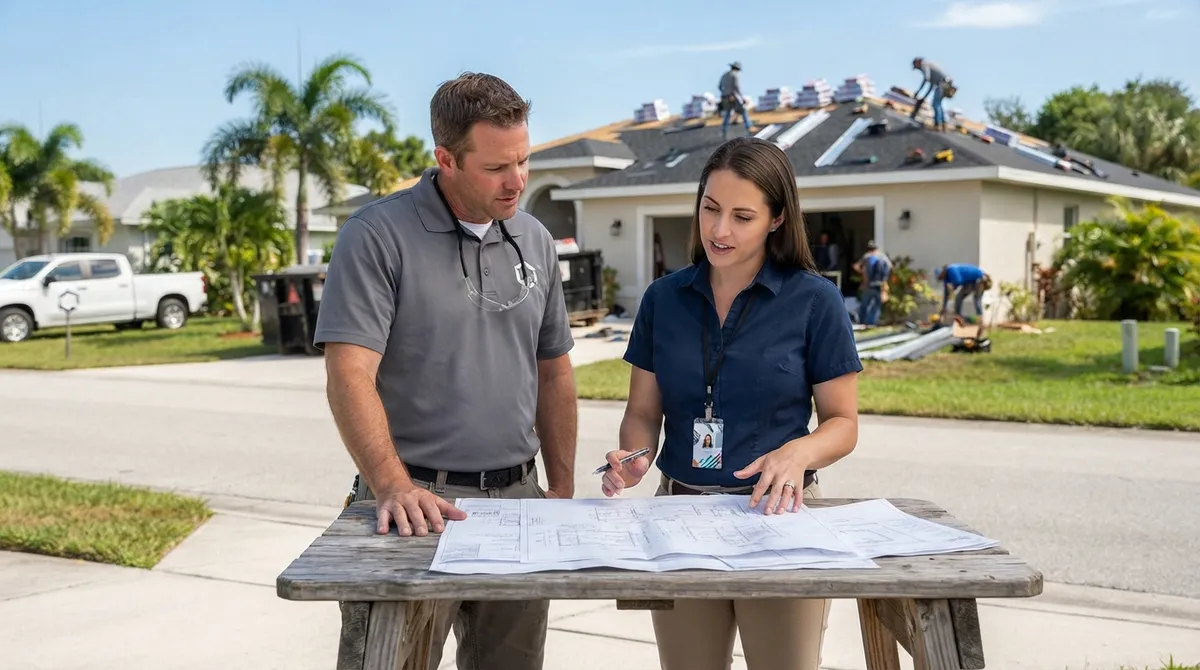
Who Should a Roofer Hire for After-the-Fact Permits in Florida?
Think of this as building a small team. Not every job needs every role, but most ATF roof permits involve at least the first two.
1. A Florida-Licensed Roofing Contractor
Under Florida Statutes, Chapter 489, contractors must subcontract roofing work unless they hold the applicable state certificate or registration for that trade. That means the permit application generally needs a licensed roofing contractor attached to it. If you installed the roof yourself and hold the proper license, you are the contractor of record. If you do not, you will need to bring in someone who does.
Be careful here. The contractor of record is responsible for the trade work and for any statements made about materials and installation. Verify the license and local registration before signing anything. Our contractor registration checklist and our article on Florida contractor license requirements can help.
2. A Permitting Specialist or Expeditor
A permitting specialist handles the paperwork maze: application forms, document packages, submission, tracking, and responding to reviewer comments. They do not replace the licensed contractor or the building official. What they do is save you time and keep the file moving. Learn more about permit facilitation and filing and what it covers.
3. A Drafter or Engineer, When Needed
Some roofs need more than a form. If the building department wants roof details, load path verification, or a sealed letter, you will need a drafter or a Florida-licensed engineer. This is especially common when the roof deck, trusses, or fastening cannot be easily verified. See our pages on engineer letters, as-built drawings, and structural engineering.
4. A Private Provider, in Some Cases
In Florida, certain projects can use a licensed private provider for plan review and inspections instead of waiting in the county queue. Whether this is available for your ATF roof depends on the jurisdiction and the situation. Read our breakdown of private provider versus building department to see if it fits.
| Professional | What They Do | What They Cannot Do |
|---|---|---|
| Licensed roofing contractor | Serves as contractor of record, stands behind the trade work | Guarantee approval or skip inspections |
| Permitting specialist / expeditor | Organizes submissions, tracks reviews, resolves administrative deficiencies | Replace the licensed contractor or the building official |
| Drafter / engineer | Prepares as-builts, roof details, sealed letters or drawings | Force a jurisdiction to accept a document |
| Private provider | Performs plan review and inspections where allowed | Operate where the jurisdiction or project type does not permit it |
Why a Local Specialist Beats a Generic One
Florida has hundreds of permitting jurisdictions, and each one has its own forms, fees, document checklists, and inspection quirks. Your roof might sit inside a city, in unincorporated county land, or in a special permitting area, and the line is not always obvious.
That is why the very first task is identifying the authority having jurisdiction. Our building department lookup tool and our guide on which Florida jurisdiction reviews my project are good starting points.
Then ask whether your specialist has actually handled ATF roof permits in that jurisdiction. High-wind and coastal areas, such as Miami-Dade County, publish a uniform roofing application and project-specific checklists. Other counties, like Hillsborough County or Sarasota County, may handle things differently. Local experience matters.
How to Vet Your Hire: Questions to Ask
Before you sign a contract, run through this checklist. A good professional will answer these without flinching.
- Is the license active? Check the Florida state license and any local registration for the jurisdiction.
- Have you done ATF roof permits in this specific jurisdiction? Ask for examples, not promises.
- What is your scope? Filing only, or filing plus drafting, engineering, and inspection coordination?
- What are your fees and timelines? No statewide standard fee or uniform processing time exists for ATF roof permits, so expect these to vary.
- Will an engineer or other licensed professional be needed? If so, who provides the seal?
- What happens if the inspector wants the roof opened up? A good partner plans for this up front.
Red Flags to Walk Away From
- Anyone promising guaranteed approval
- Anyone offering to bypass or fake inspections
- Anyone who cannot name the jurisdiction's actual process
- Anyone who wants you to misstate when or how the work was done
Honesty matters. The roofer remains responsible for accurate representations about the work, materials, and installation, so never let anyone paper over the facts.
Step-by-Step: How the Process Usually Works
Every jurisdiction differs, but most ATF roof permits follow a similar rhythm.
- Confirm the jurisdiction. Determine whether the property is under a city, county, or special permitting authority.
- Check the permit history. Use an open permit search to see whether anything is already open, expired, or missing.
- Confirm the contractor of record. Make sure a properly licensed roofing contractor will sign on.
- Gather documents. Collect the application, license and registration details, roof-system information, product approvals, photos, and any records from the original install.
- Prepare roof details or sealed documents if required. This may include as-builts or an engineer letter.
- Submit and track. Your specialist files the package and monitors review comments.
- Respond to corrections. Revisions and resubmittals are common, so plan for at least one round.
- Schedule inspections. Be ready for additional inspections, photos, or selective removal of roofing to expose concealed components.
- Pass final inspection and close the permit. Get the final documented and keep a copy.
What Documents the Building Department May Request
Requirements vary by jurisdiction and roof type, but expect some combination of the following:
| Document | Why It Matters |
|---|---|
| Permit application | Starts the formal review |
| Contractor license and registration | Confirms who is authorized to do the work |
| Roof-system information | Describes materials and assembly |
| Product approvals | Shows products meet Florida wind and code standards |
| Plans or roof details | Verifies layout, slope, edge details, and fastening |
| Affidavits or inspection documentation | Supports claims about the installation |
| Photos and installation records | Helps verify concealed work |
If product approvals are your sticking point, our article on Miami-Dade NOA versus Florida product approval clears up a common confusion.
Be Ready for Inspections That Dig Deeper
Here is the part that surprises people. A finished roof hides a lot: fasteners, decking, underlayment, flashing details. Because those components are concealed, the inspector may ask you to expose some of them, make repairs, or provide extra proof.
That is why you should never assume an ATF permit will sail through just because the roof looks great. Plan for possible selective removal, corrections, and reinspection. Budget time and money accordingly. If trusses or structural elements are in question, our piece on truss verification after the fact in Florida explains what to expect.
Costs, Timelines, and Penalties
You will want hard numbers, and here is the honest answer: there is no statewide standard fee or uniform processing time for ATF roofing permits. Fees, penalties, documentation, and inspection procedures are set or administered by the local authority.
One useful general rule: Miami-Dade County notes that a permit may expire if work does not start or an approved inspection does not occur within 180 days, with an additional 180-day extension process described. That is a general permit-validity rule, not an ATF-specific deadline, so confirm your own jurisdiction's rules.
For budgeting help, read about after-the-fact permit costs in Florida and the penalty for building without a permit in Florida.
Special Situations Worth Knowing
The Permit Is Open or Expired
Sometimes the roof was permitted but the permit expired without a final inspection. That is a different fix than a true unpermitted roof. See after-the-fact and expired permits and our guide to closing an expired permit in Florida.
A Real Estate Closing Is Looming
If a sale is on the clock, speed matters. An open or missing roof permit can stall a closing, and lenders or insurers may demand resolution. Realtors and sellers can look at our realtor and closing support and our article on open permits found at closing.
A Code Enforcement Notice Has Arrived
If the county or city has already cited the property, your response timeline may be tighter. Our resources on code compliance violations and urgent permit rescue are built for exactly this.
You Are Handling Many Roofs at Once
Roofing companies with a backlog of unpermitted jobs often benefit from a repeatable process. Our Roof Permit Partnership Program is designed for contractors who need volume handled consistently.
Where 1 Contractor Solutions Fits In
We are not a roofing contractor. We act as Florida's outsourced permitting department, which means we handle the filing, tracking, plan review coordination, revisions, and closeout, while our in-house drafting and engineering team prepares sealed documents when your jurisdiction asks for them. We work across all 67 Florida counties, respond within 30 minutes, and can help you determine early whether your roof needs a simple permit package or something more involved.
You can read what customers say about us when you visit us on Google — 1 Contractor Solutions, or follow us on LinkedIn and follow us on Facebook for updates. For roofers specifically, see our page for roofing contractors and our overview of roof permits.
Quick Decision Guide: Who Do You Need?
| Your Situation | Most Likely Hire |
|---|---|
| Licensed roofer, simple roof, cooperative jurisdiction | Permitting specialist for filing and tracking |
| Roofer without the right license | Licensed roofing contractor of record plus a specialist |
| Concealed work cannot be verified | Specialist plus an engineer for a sealed letter or drawings |
| Tight closing deadline or stop work order | Urgent permit rescue team plus contractor of record |
| Many unpermitted roofs | Partnership-style permitting support |
The Bottom Line
When you ask who should a roofer hire for after the fact permits in Florida, the answer is a team, not a single hero. A licensed roofing contractor of record, a permitting specialist who knows your jurisdiction, and an engineer or drafter when the building department wants proof. Add honesty, patience, and a plan for possible inspections, and you can turn an awkward problem into a closed permit.
Do not wait for a citation or a collapsed closing to act. If you are ready to sort this out, get a free quote and tell us the address. We will tell you which jurisdiction controls it, what it will take, and then we will go do it.
FAQs
Who can apply for an after-the-fact roofing permit in Florida?
Generally, the application is filed by or on behalf of a Florida-licensed roofing contractor who is authorized to do the work. A permitting specialist can prepare and submit the paperwork for you, but the licensed contractor stays responsible for the trade work. Some jurisdictions have owner-builder options, so check your local rules.
Will inspectors make me remove part of a completed roof?
Possibly, and it is smart to plan for it. Because fasteners, decking, and underlayment get covered up, inspectors may ask you to expose sections or provide extra documentation. Having photos, records, and an engineer ready can sometimes reduce how much needs to be opened.
How much does an after-the-fact roofing permit cost in Florida?
There is no single statewide fee. Costs, penalties, and processing times are set by each local building department, so your jurisdiction's fee schedule is what counts. Ask your permitting specialist for a written estimate that separates permit fees from professional service fees.
Should I hire a permit expeditor or a licensed roofing contractor?
Most roofers need both, because they do different jobs. The licensed contractor stands behind the work, while the expeditor keeps the paperwork and reviews moving. Neither one can guarantee approval, since the building official makes the final decision.
Can I get a permit for a roof that has already been installed in Florida?
In many jurisdictions, yes. Miami-Dade County, for example, states that permits and inspections can still be obtained for work already completed without a permit, though portions may need to be uncovered for inspection. Always confirm the process with the local building department for your specific property.
We do this work every day across all 67 Florida counties. Call (866) 314-6931 and we will tell you what your situation actually requires — including when you do not need us.
Related services
Permit Facilitation & Filing
You have a crew scheduled, a client asking for dates, and a permit sitting somewhere in a queue you cannot see. We file it, w…
See the servicePlan Review Coordination
A permit in plan review is not one queue. On a commercial project it can be six queues, each with its own reviewer, its own c…
See the serviceReady to get your permit moving?
One call tells you which jurisdiction controls your project, what it will take, and what it will cost. Most of the time we can scope it on the phone.