
Blog
How to Legalize an Unpermitted Kitchen Remodel in Florida
Wondering how to legalize an unpermitted kitchen remodel in Florida? Learn the steps, permits, inspections, and costs to get your kitchen approved.
Key Takeaways
-
Contact the local building department first and ask which permits apply, since Florida permitting is administered by each city or county and the requirements vary by jurisdiction.
-
Before opening any walls, ask the building official what evidence they need, since they may accept photos, receipts, or engineer letters instead of exposing concealed wiring or plumbing.
-
Permit scope matters: cosmetic updates and cabinet swaps that leave electrical, plumbing, and mechanical systems in place are often exempt, while moving a sink, adding circuits, relocating gas lines, or removing walls usually requires permits.
-
Paying the after-the-fact fee does not legalize the work; the kitchen becomes legal only after passing required inspections and receiving final approval that closes out the permit.
-
Gather as-built drawings, contractor or owner-builder details, product information, and photos of the finished work to support the after-the-fact application.
-
Respond quickly to any correction notice and use licensed trades for fixes, since prompt action avoids code enforcement complications and keeps real estate closings on track.
So you just found out your kitchen remodel was done without a permit. Maybe a previous owner did it. Maybe a contractor skipped the paperwork. Maybe a home inspector flagged it right before closing. First, take a breath. You are far from the first Florida homeowner in this spot, and there is a clear path forward.
If you are asking, how do I legalize an unpermitted kitchen remodel in Florida, the short answer is this. Contact the local building department, find out which permits apply, submit an after-the-fact application with the right documents, and pass any inspections the building official requires. It sounds like a lot. Broken into steps, though, it is very doable.
In this guide, we walk through the whole process in plain English. You will learn when a kitchen remodel needs a permit, what the building department may ask for, how inspections work on finished kitchens, and when it makes sense to bring in a professional. Let's get your kitchen on solid legal ground in 2026.
Why Unpermitted Kitchen Work Matters in Florida
Florida Statutes §553.79 generally requires a permit before regulated construction, alteration, modification, or repair begins. Local enforcing agencies issue those permits and inspect the work. In plain terms, a permit is how the local government confirms your kitchen is safe.
Kitchens are packed with systems that can cause real problems when done wrong:
- Electrical: new circuits for appliances, countertop outlets, and lighting
- Plumbing: sink relocations, dishwasher hookups, and drain lines
- Gas: range or cooktop lines that must be sealed and tested
- Mechanical: range hoods and ventilation ducting
- Structural: removed walls, new openings, or altered framing
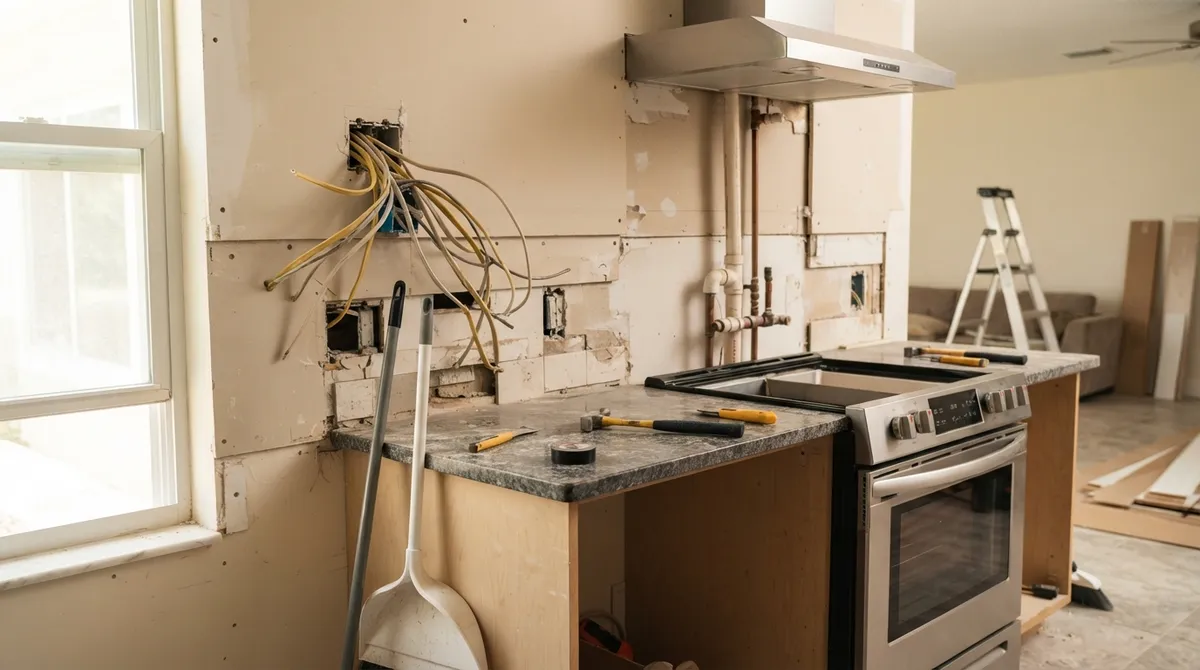
When this work goes uninspected, hidden problems can sit behind your walls for years. That is why unpermitted work can cause headaches with insurance, resale, and refinancing. It can also trigger code enforcement attention.
Did Your Kitchen Remodel Actually Need a Permit?
Before you assume the worst, check whether a permit was required in the first place. Not every kitchen update needs one. Local guidance commonly exempts cosmetic work and limited cabinet replacement when electrical, plumbing, or mechanical systems are not moved.
For example, Seminole County lists cabinet replacement as permit-exempt when systems stay in place and new items are reconnected in the same location. On the other hand, Fort Walton Beach says alteration permits are required for kitchen or bathroom remodels that involve removing all cabinets and plumbing, gas, or electrical fixtures. They are also required when drywall is removed or walls are added or removed.
Exemptions vary by jurisdiction, so always confirm with your local building department before you decide. Here is a quick comparison to help you think it through:
| Type of Kitchen Work | Permit Likely Needed? | Why |
|---|---|---|
| Painting, new backsplash, cosmetic updates | Usually no | No systems or structure changed |
| Swapping cabinets in the same layout | Often no | Exempt in many places if systems stay put |
| Moving the sink or adding plumbing lines | Yes | Plumbing permit and inspection |
| New circuits, panel changes, added outlets | Yes | Electrical permit and inspection |
| New gas range line or relocated gas | Yes | Gas permit and pressure test |
| Removing or adding walls | Yes | Building permit, possibly structural review |
| New range hood ducting | Often yes | Mechanical permit may apply |
Not sure where your project falls? Our building department lookup tool can help you find who has jurisdiction over your address. This matters near city lines, where the county and the city may not be who you expect.
Step-by-Step: How to Legalize an Unpermitted Kitchen Remodel
Every Florida jurisdiction runs its own process. Still, the overall path looks similar nearly everywhere. Here is the general roadmap:
- Identify the right building department. Florida permitting is administered locally, so start with the city or county that has jurisdiction over your property.
- Check for open permits or code cases. Before you file anything, find out whether any permits or violations already exist on the property. Our open permit search tool is a good starting point.
- Document what was actually done. Walk the kitchen and list every change. Note any moved plumbing, new circuits, gas lines, removed walls, and new ventilation.
- Ask which application to file. Many departments require an after-the-fact permit or another corrective process. Ask before you open any walls or remove any finishes.
- Prepare plans and supporting documents. The department may want drawings of the existing kitchen, contractor information, and a clear scope of work.
- Submit the application and pay the fees. Fees are set locally, so ask for the current after-the-fact fee schedule.
- Complete the required inspections. Passing inspection is what counts. Paying a fee alone does not legalize the work.
- Close out the permit. Once final approval is issued, your kitchen is documented and legal.
That last point deserves repeating. A fee does not make work legal. Inspections and final approval do.
Which Permits Might You Need?
A single kitchen remodel can involve several permit types at once. Here is how they usually break down:
| Permit Type | Typical Kitchen Triggers | Likely Inspection |
|---|---|---|
| Building / Alteration | Wall changes, new openings, drywall removal | Framing and final building |
| Electrical | New circuits, outlets, panel work, lighting changes | Rough-in and final electrical |
| Plumbing | Sink moves, new drains, dishwasher lines | Rough-in and final plumbing |
| Mechanical | Range hood ducting, ventilation changes | Mechanical final |
| Gas | New or relocated gas lines | Pressure test and final gas |
The building official decides which of these apply. That decision depends on the jurisdiction and on exactly what was changed in your kitchen.
What About Work Hidden Behind Walls?
This is the question that worries most homeowners. Kitchen walls are already closed, cabinets are installed, and the drywall is painted. How does an inspector verify wiring or pipes they cannot see?
The honest answer is that it depends on the project and the jurisdiction. The building official determines what evidence is needed to verify code compliance. If wiring, plumbing, gas lines, or framing cannot be inspected as they stand, the owner may be asked to do one of the following:
- Expose the concealed work so it can be inspected
- Provide acceptable documentation, such as photos, receipts, or engineer letters
- Correct or replace the work so it meets code
Here is a friendly tip. Ask the building department what they need before you open any walls. Sometimes a limited opening in one spot is enough. Other times, documentation or an engineer's letter can do the job. Tearing out drywall too early can create extra mess and cost you did not need.
If you want to understand what verification can look like, our guide on what happens during a Florida after-the-fact site inspection walks through it step by step.
What Documents Will You Likely Need?
Requirements differ by jurisdiction, but most after-the-fact applications for kitchen work ask for some mix of the following:
- A completed permit application for each applicable trade
- Drawings showing the existing kitchen layout, often called as-built drawings
- Contractor license and insurance details, or owner-builder paperwork where allowed
- Product information for items like range hoods or electrical panels
- Engineer letters or sealed documentation if structural changes were made
- Photos of the finished work and any visible connections
If walls were moved or removed, you will almost certainly need structural review. Our structural engineering team handles in-house sealed drawings for exactly this situation. For electrical, plumbing, and mechanical questions, our MEP engineering services can fill the gaps.
What Will It Cost?
Everyone wants a number here, and we wish we could hand you one statewide. The truth is that no single Florida standard exists. Florida law requires permits for regulated work, but local agencies set their own permit fees and administer enforcement. Some jurisdictions charge a surcharge for after-the-fact applications. Others simply charge standard fees.
Your total cost will generally depend on a few things:
- The number of permit types required
- Local application and inspection fees
- The cost of drawings or engineer letters
- Any corrective work the inspector requires
- Whether an open code-enforcement case adds penalties
For a closer look at what drives pricing, check out our breakdown of after-the-fact permit costs in Florida. And remember to ask your jurisdiction for its current fee schedule before you budget.
What If the Work Fails Inspection?
It happens, and it is not the end of the world. If an inspector finds something that does not meet code, you will typically get a correction notice explaining what needs to change. You then fix the issue and schedule a re-inspection.
Common kitchen corrections include adding GFCI protection at countertop outlets, fixing improper venting, correcting gas line connections, or adding proper support where framing was altered. A good permitting professional can read the correction notice, coordinate the right licensed trade, and handle the revisions and resubmittals for you.
If you have already received a violation notice, our guide on what to do about a Florida code enforcement notice is a helpful read. Responding promptly almost always works better than waiting.
Selling, Refinancing, or Buying With an Unpermitted Kitchen
Real estate timelines make this problem feel urgent. A buyer's inspector spots a remodel with no permit history. A lender asks questions. A title search turns up something odd. Suddenly, a closing date is at risk.
If you are in that spot, it usually makes sense to resolve the issue as early as possible. Legalizing the kitchen before closing can keep deals alive and protect your sale price. Agents and investors may want to read our guide on fixing a closing delayed by unpermitted work. If you are a buyer who discovered the problem, see how to handle unpermitted work you found as a Florida buyer.
Our realtor and closing support service exists for these time-sensitive situations.
DIY or Hire a Permitting Professional?
Some homeowners handle the process on their own, especially when the work is simple and the building department is friendly. Others find that the paperwork, plan drawing, and trade coordination quickly eat up evenings and weekends. Here is a side-by-side look:
| Factor | DIY Approach | With a Permitting Professional |
|---|---|---|
| Finding the right jurisdiction | Research on your own | Handled for you |
| Drawings and sealed documents | Must hire separately | Often coordinated in one place |
| Responding to reviewer comments | You manage back-and-forth | Professional works the comments |
| Scheduling inspections | You schedule and attend | Coordinated on your behalf |
| Time commitment | High | Low for you |
| Approval guarantee | None | None, since the building official decides |
No professional can guarantee approval or waive code requirements. Those calls belong to the local building official. What a good permitting team can do is save you time, prevent avoidable mistakes, and keep the process moving.
That is where 1 Contractor Solutions comes in. We act as Florida's outsourced permitting department. We identify the controlling jurisdiction, prepare the plans, file the application, track it, work every reviewer comment, and carry it through to closeout. Because our drafting and engineering are in house, we can fix issues quickly instead of waiting on an outside consultant. Learn more about our after-the-fact and expired permit services.
Tips for a Smoother Legalization Process
After helping with thousands of Florida permits, a few lessons come up again and again. Keep these in mind:
- Call before you demo. Ask the building department what they need before opening any walls.
- Gather paper trails. Old receipts, photos, appliance manuals, and contractor invoices can all help show what was installed.
- Use licensed trades for corrections. If electrical or plumbing fixes are needed, licensed contractors keep the process clean.
- Respond to notices quickly. Silence rarely helps and often adds complications.
- Keep everything organized. One folder with every application, comment, and approval saves headaches later.
- Close the permit completely. An open or expired permit can cause new problems down the road, so follow through to final approval.
For an even broader look at the topic, see our guide on how to fix an unpermitted kitchen remodel in Florida and our overview of unpermitted work in Florida and how to legalize it.
Conclusion: You Can Get This Fixed
An unpermitted kitchen remodel feels stressful, but it is a solvable problem. The path is straightforward. Contact the right building department, confirm which permits apply, submit your after-the-fact application with the right documents, and complete the inspections. Local rules vary, so always confirm details with your jurisdiction before you take action.
You do not have to figure it all out alone. If you would like a friendly team to take the paperwork, plans, and inspection coordination off your plate, get a free quote from 1 Contractor Solutions today. We respond within 30 minutes, day or night, and we serve all 67 Florida counties.
Want to see what other Floridians say about working with us? Visit us on Google — 1 Contractor Solutions to read reviews. You can also follow us on LinkedIn and follow us on Facebook for more Florida permitting tips.
FAQs
Do I need a permit to remodel a kitchen in Florida?
It depends on the scope. Cosmetic updates and simple cabinet swaps are often exempt when electrical, plumbing, and mechanical systems stay in place. Moving a sink, adding circuits, relocating gas lines, or removing walls generally requires permits, so confirm with your local building department.
Will I have to open walls to inspect unpermitted kitchen work?
Not always. The building official decides what evidence is needed. You may be asked to expose concealed work, provide acceptable documentation, or correct the work, so ask the department before you tear anything out.
How much does an after-the-fact kitchen permit cost in Florida?
There is no single statewide price. Local agencies set their own permit fees, and some add after-the-fact surcharges. Ask your jurisdiction for its current fee schedule, and budget for drawings and any corrective work too.
Can I sell or refinance a Florida home with an unpermitted kitchen remodel?
You can sometimes, but unpermitted work often slows or complicates closings and lender approvals. Legalizing the kitchen before listing or refinancing usually makes things much smoother and protects your sale.
Can a Florida permitting service help legalize work done by a previous owner?
Absolutely. A permitting professional can identify the right jurisdiction, prepare the plans, file the application, and coordinate inspections. They cannot guarantee approval, since the local building official makes the final call.
We do this work every day across all 67 Florida counties. Call (866) 314-6931 and we will tell you what your situation actually requires — including when you do not need us.
Related services
Permit Facilitation & Filing
You have a crew scheduled, a client asking for dates, and a permit sitting somewhere in a queue you cannot see. We file it, w…
See the servicePlan Review Coordination
A permit in plan review is not one queue. On a commercial project it can be six queues, each with its own reviewer, its own c…
See the serviceReady to get your permit moving?
One call tells you which jurisdiction controls your project, what it will take, and what it will cost. Most of the time we can scope it on the phone.